
BMC Remedy: Introduction To IT Service Management Capabilities

Incident and Problem Management Capabilities in a Remedy-style ITSM Platform
Incident handling typically focuses on restoring normal service operations quickly by recording incidents, assigning ownership, and tracking resolution steps. Problem management focuses on identifying root causes and reducing recurrence through investigations and known-error records. In practice, incident and problem records often link: a recurring incident may generate a problem investigation, and problem resolutions may produce changes. Teams often configure categorization schemes and priority matrices to ensure consistent triage and escalation; these schemes may be revised periodically as operational patterns change.
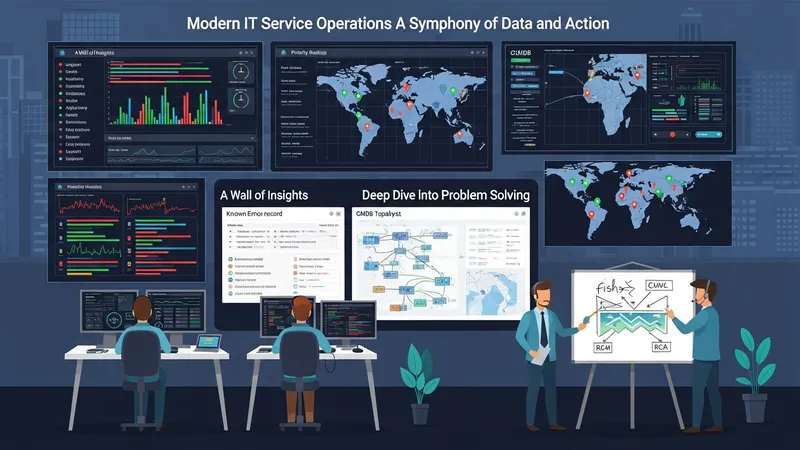
Common operational considerations include how incidents are routed—by skill group, service, or location—and how SLAs are applied based on priority. Automated routing rules and escalation paths can reduce manual reassignments but typically require clear definitions of roles and on-call rotations. Problem investigations may use structured templates for root-cause analysis and may integrate with the CMDB to identify affected configuration items. Organizations often treat problem management as a longer-cycle activity that complements the immediacy of incident response.
Data quality and reporting are central to assessing incident and problem outcomes. Typical metrics include ticket volumes by category, time to acknowledge, time to resolve, and repeat incident rates. Dashboards that combine incident trends with CMDB data can illustrate which services are most frequently affected. Teams commonly schedule periodic reviews of recurring incidents to decide whether problem investigations or proactive changes are warranted, and they may retain known-error records that link to knowledge articles used by agents and end users.
Insider considerations include starting with high-volume or high-impact service buckets to refine triage rules and knowledge content before scaling. It may be helpful to pilot automation for routine categorization or assignment and to monitor for edge cases that need manual handling. Over time, reviewing incident-to-problem transitions and the backlog of known errors can inform prioritization of corrective change activities. Readers may find it useful to track how configuration data supports impact analysis for recurring incidents.