
Food Industry Metal Detectors: Principles Of Operation And Key Components

Product and packaging factors; conveyor and pipeline system integration for metal detection
Product composition and form significantly affect detection outcomes. Conductive or high-moisture products can generate signal effects that partly mask metal contamination, a phenomenon often called the product effect. Granular, particulate or heterogeneous products can exhibit variable dielectric properties as they pass through an aperture, so detector settings may require tuning to the dominant product characteristics. Manufacturers and quality teams typically evaluate sensitivity under realistic production conditions because laboratory measures may not match on-line performance for a given product.
Packaging materials introduce another layer of complexity. Metalised films, aluminium foil crimps, or metallised laminates can create background signals that reduce effective sensitivity to separate contaminants; conductive packaging next to a metal contaminant may also create compound signals. In some lines, detectors are placed prior to final packaging to reduce the masking effect of metallic packaging, while in other cases, X-ray inspection may be used in parallel if packaging routinely includes metallic layers. The choice depends on product flow, packaging type, and regulatory or quality requirements.
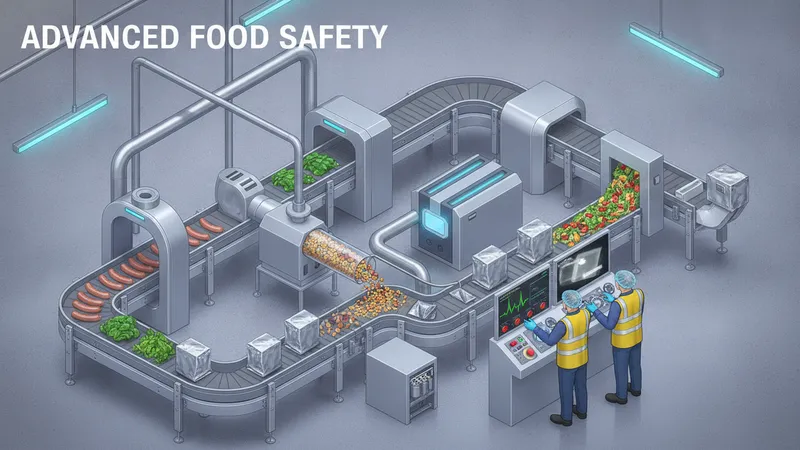
Conveyor and pipeline integration requires both mechanical and electrical attention. Conveyor-mounted detectors must be positioned to ensure consistent product presentation—centred on the aperture, minimal overlap, and steady spacing—to enable predictable detection probabilities. Pipeline detectors are typically installed in hygienic pipe sections or assemblies designed to permit CIP (clean-in-place) procedures without disassembly. Integration planning often considers cleanability, access for testing and maintenance, and how rejection devices will be mounted and drained or cleared to avoid product loss or contamination.
Operational considerations often include speed, throughput and maintenance windows. Faster lines may demand detectors with higher sampling rates and faster processing to register brief perturbations, while high-throughput lines increase the importance of reliable reject timing and minimal downstream impact. Maintenance planning typically involves scheduled cleaning and inspection of coil housings and reject actuators, validation testing with test pieces, and periodic review of detector settings when product recipes or packaging change. These measures are framed as ongoing operational controls rather than one-time adjustments.