
Heating Element Manufacturers: Key Production Processes And Industry Standards

Industry Standards, Compliance Topics, and Common Applications for Heating Elements
Industry frameworks that influence heating-element design include general electrical safety standards, environmental regulations, and product-type specifications relevant to the intended market. Standards organizations such as international electrotechnical and national testing bodies publish test methods and safety guidelines that manufacturers may reference. Environmental compliance may require limits on specific substances or material declarations for supply-chain transparency. Manufacturers commonly align their documentation and testing to address applicable standards for regions where the products will be installed.
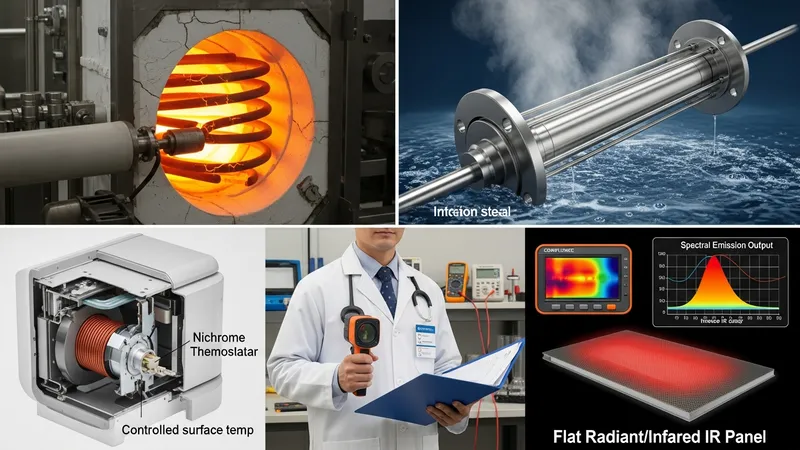
Common applications illustrate how manufacturing choices map to use cases. Industrial furnaces and process heaters typically demand elements that tolerate high temperatures and cyclical loads, prompting use of high-temperature alloys and robust sheathing. Immersion heaters for liquids emphasize corrosion resistance and reliable sealing. Consumer appliances often prioritize cost-effective materials, controlled surface temperatures, and consistent serial production. Radiant and infrared units are designed for spectral output and emitter durability, which may influence coating and substrate selection.
Compliance and market-entry considerations often shape production documentation and test depth. For example, elements destined for regulated equipment may need clearly defined test matrices and traceability to material certificates, while those for laboratory or industrial use may emphasize performance under specified duty cycles. Manufacturers may also maintain recommended installation guidance that addresses mounting, electrical supply, and environmental exposure to reduce the likelihood of misuse-related degradation, stated as considerations rather than guarantees of outcome.
In selecting or designing heating elements, stakeholders typically weigh application-specific factors—expected on/off cycles, maximum temperatures, exposure to corrosives, and space constraints—against available construction approaches. Close communication between design engineers and manufacturing teams can reduce rework and lead to elements whose materials, fabrication methods, and test regimes align with end-use expectations. Further technical detail on these components appears earlier in this article’s sections on materials, fabrication, testing, and safety practices.