
Machine Learning Courses: Key Topics, Skills, And Learning Outcomes

Programming, Tools, and Frameworks related to Machine Learning Courses: Key Topics, Skills, and Learning Outcomes
Programming instruction typically centers on a main language and associated libraries for data manipulation and modeling. Many programs use a scripting language for examples, showing how to load data, perform transformations, and prototype models. Tool-focused lessons may introduce data-processing libraries, plotting utilities for exploratory analysis, and serialization formats for saving results. Practical labs often demonstrate how to structure code into notebooks or modules and how to manage environments to ensure reproducible execution across systems.
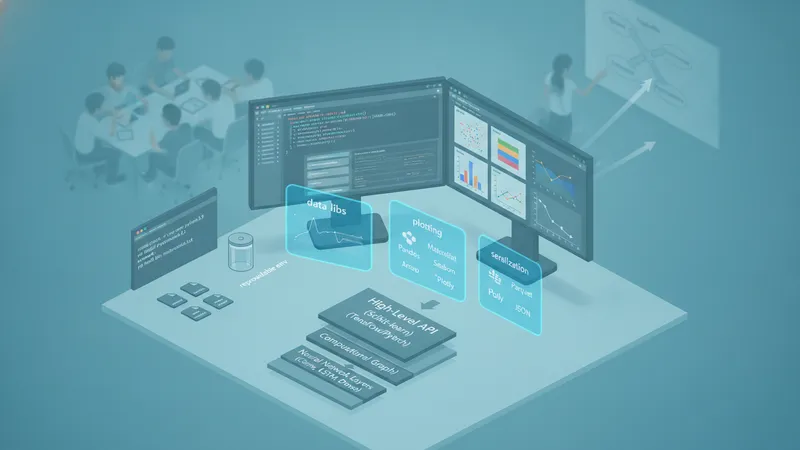
Frameworks for model development and experimentation are commonly covered so learners can implement and test algorithms efficiently. Examples may include widely used libraries for traditional machine learning and specialized frameworks for gradient-based training of deep models. Instruction may explain differences between high-level APIs for rapid prototyping and lower-level constructs used when customizing architectures. Courses often include examples that highlight the trade-offs between development speed, transparency, and performance.
Computational and deployment tools may be introduced to show how models move from experimentation to production-like settings. Topics can include serialization formats for saving trained models, basic considerations for serving models as part of an application, and monitoring of model outputs over time. Performance profiling and resource estimation are sometimes taught so learners can anticipate memory and compute requirements for different model classes and dataset sizes. These sections tend to be conceptual rather than exhaustive operational guides.
Practical tips in tool-related modules often focus on reproducibility and documentation: freezing dependencies, using random seeds judiciously, and tracking experiments with simple logging. Instructors may demonstrate lightweight experiment-tracking options and emphasize that systematic recording of hyperparameters, data versions, and metric results supports later analysis. These practices often improve collaboration and diagnostic ability, which are common learning outcomes of applied coursework.